 Skip to content

How Do You Open a Mental Health Clinic?
To open a mental health clinic, you must first form your business entity, define your service model (outpatient, IOP, PHP, or telehealth), and complete a market feasibility study. From there, you secure a compliant location, obtain state mental health licensure plus HIPAA and 42 CFR Part 2 compliance, hire licensed clinical staff and a medical director, get credentialed with insurance payers, and launch with a compliant EHR and marketing plan.
Most founders complete this in about six months with the help of a mental health startup consultant like Strategique Partners.
Key Takeaways
- Opening a mental health clinic takes about six months of planning on average, most of it consumed by licensing (3–6 months) and payer credentialing.¹
- Startup costs range widely by model: roughly $50,000–$150,000 for a solo practice up to $300,000–$600,000+ for a PHP/IOP program.²
- You need both state-level licensure and federal-level compliance (HIPAA, 42 CFR Part 2 if offering SUD services, CMS enrollment) before you can bill payers.
- Global mental illness prevalence is projected to grow roughly 15% by 2030, which is the demand backdrop driving this market.³
- Strategique Partners’ company startup services cover feasibility, licensing, staffing, and launch so you can avoid the delays that push most new clinics past their planned opening date.
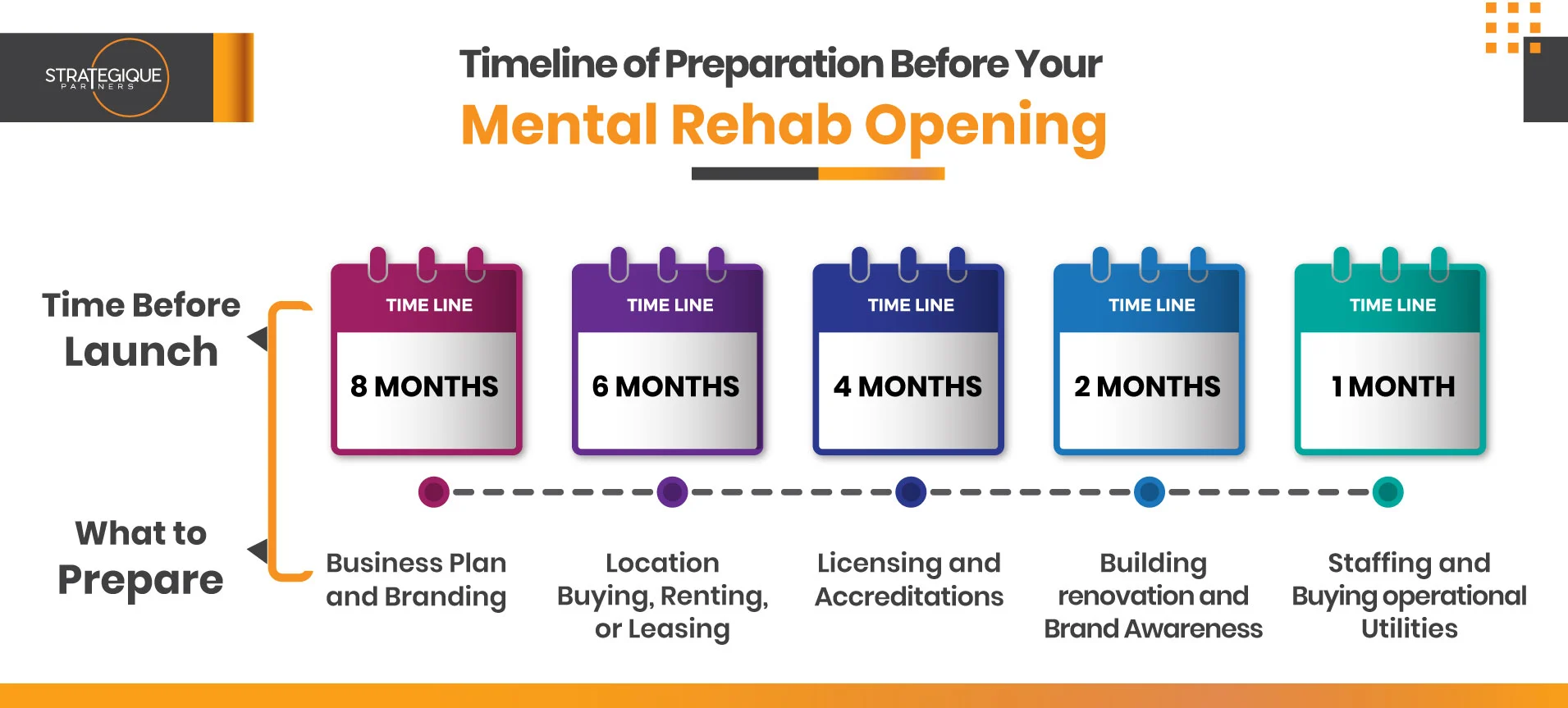
Learning how to open a mental health clinic, or a smaller mental health practice, usually comes down to the same handful of building blocks, done in roughly the right order and with enough lead time. Most founders need about six months to move from a plan on paper to a compliant, staffed, open facility.
You will need to work through certain elements such as:
- Brand building
- Legal and accreditation requirements
- Hire expert staff
- Business planning
- Choose location
Are you looking for industry-specific guidance to help establish a mental health startup in your state? Strategique Partners offers feasibility studies & market research to help you map out your endeavor.
How to Open a Mental Health Clinic: Stepwise Guide From a Behavioral Health Expert’s Perspective
Once you’ve decided to invest in behavioral health, it’s time to turn that vision into action, and it all starts with market research. That research shapes your service model early on, because the model you choose changes almost everything downstream.
A clinic following intensive outpatient program requirements tends to have different staffing needs and startup costs than a straightforward outpatient practice.
Step 1: Make a Vision of What You Want by Conducting Market Research
Take an overview of your desired market and location where you will plan your business startup. While doing market analysis and research, you will need to come across the following aspects:
- Learn all the mental health therapies required in the area
- Analyze community needs in the mental health industry
- Research your competitors and talk to them about their business experience
- Build a network with professionals and attorneys to know the exact legal requirements
- Conduct a feasibility assessment to determine whether your area offers a sound output
- Hire behavioral health business experts to evaluate legal requirements
Knowing how to start a mental health business can help you turn your vision into practical implementation regarding mental health practices, making it easier to create a comprehensive business plan to avoid losses.
Step 2: Devise Branding to Fulfill Legal and Regulatory Compliance
Your brand is your identity, but in mental health, that identity only holds up once the legal and behavioral health accreditation work behind it is reliable. Get that foundation right, and branding does three things for you:
- Gives you a marketing and legal framework to build on
- Builds trust in the community
- Signals long-term commitment to the field
Branding, in turn, is only possible once the mental health facility you’re launching has its legal and regulatory foundation in place. That foundation includes:
LLC for private mental health business license; of course, we can help you with that.
- You will need an Employer Identification Number (EIN) and a National Provider Identifier via the NPPES registry (NPI) for each clinician and mental health therapist you hire.
- Mental health-specific licenses and accreditation, such as JCAHO and CARF.
- National Accreditation Board for Hospitals and Healthcare Providers (NABH) for getting on the insurance panel.
What Licenses Should You Care About for a Mental Health Startup Clinic?
Mental health clinic licensing is multilayered, which means it can be really confusing for a newbie. However, the market is very strict, which means you cannot claim anything based on ignorance. This is why knowing each licensing requirement that applies to your mental health business is your responsibility, and licensing experts can help you with that. Here, we will name various licensing approvals that are required for a mental health business:
- A state license for mental health practice is individually granted by the state in which you operate. Each state has its own behavioral health business licensing body, and each has its own requirements. For instance, DHCS in California, DCF in Florida, OASAS in New York, and other state licensing authorities have different licensing processes, requirements, and fees.
- HIPAA compliance requirements, 42 CFR Part 2 if offering SUD services, CMS enrollment for Medicare, and the CCBHC designation pathway for federal funding access are all federal-level compliance requirements that are critical for mental health startups.
- Zoning and other local laws are applied in the specific locality or county where you decide to operate.
One thing that is often overlooked by new starters is the timeline of seeking these licensing and compliance approvals. It can take months in most of the states. On average, many states’ mental health licenses take 3–6 months from application to approval. However, it can take longer if you do not fulfill the criteria. It also costs you high licensing fees, which are not returned if you fail the review.
All the fuss for branding and legality is challenging. However, expert guidance is always available for those seeking virtuous goals at Strategique Partners! Similarly, companies that buy mental health practices look for businesses that are accredited and follow regulatory compliance.
Step 3: Develop a Thriving Business Plan and Allocate Finances
Starting a mental health business needs appropriate preparing for launch efforts, and the same is the case with the mental health industry, as it is unique and requires careful consideration in every aspect. While documenting the business plan, you will consider the following points:
- How much money you will need to make to carry on the business
- What type of treatment programs will you offer in mental therapy
- What should be the facility size and furnishing needs
- Allocating appropriate budget to expenses and setting aside for emergency cases
- Set up standard operating procedures for your mental health facility
- Allocating the budget to appropriate software/equipment to ensure medical records and data tracking
You might be wondering where to begin and what to include. Don’t worry. Our mental health experts can help you create your perfect business plan to maximize ROI.
Mental Health Treatment Model Selection
One of the most consequential decisions you will make when developing your mental health startup is selecting clinical models. Mainly, you have options such as:
- Outpatient therapy practice
- Group clinic
- Partial hospitalization program for mental health
- Intensive outpatient program
- Telehealth business for mental health services
This decision has to be made very carefully, as each one caters to a specific need and is suitable for a particular category of clients. Additionally, each one is differentiated by multiple critical factors, such as:
Licensing is mostly different for those models that are clinically more intensive and offer residential services
- Staffing, as each type of mental health treatment model has its own mental health clinic staffing needs
- Capital expenditures and the cost of opening each type of mental health business are different.
- Reimbursement rates, or what you get from the service offerings, are different for each type of business.
- EBITDA profiles and multiples
Behavioral health program development experts can help you understand model selection and how to map out your mental health clinic’s services.
How Much Does It Cost to Open a Mental Health Clinic?
Opening a mental health clinic comes with a handful of cost categories that apply no matter which model you choose. Budget for all of them up front, not just the obvious ones like rent, and you’ll steer clear of cash flow challenges for mental health clinics down the road.
Real estate leasing or build-out, and added renovation, can cost $150,000 on average. It can be higher or lower based on your ground realities and preferences
- A mental health EHR can cost $200–$600 per clinician monthly
- Liability insurance can cost up to $1,500 annually
- Licensing fees, which can cost you anything between $500–$2,500
- Initial staffing for a 3-month runway can cost you $127,000 for a large clinic
- Marketing/Website costs $500–$3,000
- One-time equipment costs can be as high as $1,000. It includes a computer, a high-quality webcam, and a microphone.
Costs also vary based on the program type for the mental health services. This table gives you a cumulative startup cost for each type:
| Program Type | Cumulative Cost |
| Solo practice | $50K–$150K |
| Group outpatient with 5 to 8 clinicians | $150K–$300K |
| PHP/IOP program | $300K–$600K+ |
| Telehealth mental health business | $4,000–$15,000 |
Although we’ve covered all the essentials of the financials and costs involved in your mental health start-up venture, you may also find additional details in our how much does it cost to open a mental health clinic guide.
Unique Tip for Mental Health Startups
Mental health clinics should incorporate outpatient-type treatment during their initial days, as it ensures a better experience and improves the administrative abilities of newly hired staff. After a while, when the brand is trusted and known around the area, one may move to offer full inpatient services with good capital behind it.
Step 4: Decide Where You Will Begin Your Business Location
Location does more than put a roof over your clinic, as it shapes how the community sees your brand and how easily clients can find and trust you. For the right location, look for:
- Seek a secure, confidential, and appropriate space with appropriate zoning laws
- According to your business plan, buy, rent, or lease a suitable business or hire a behavioral health real estate agent.
- Equip it with proper furnishings and renovate it according to your brand theme
- Choose your phone number and mark your address according to the location
Key Points to Consider While Choosing a Mental Health Location Space
- Private rooms for psychiatric consultations with clients
- Technology rooms with machines for psychiatric testing such as ECG.
- Eco-friendly environment with appropriate heating/cooling facility
- Rooms equipped with emergency equipment and precautions to prevent deliberate self-harm (DSH)
Getting the location right takes patience and long-term thinking, as this is one step where it really pays to bring in outside expertise instead of guessing.
Step 5: Hire a Seasoned and Licensed Therapist
Beyond therapists, some clinics add a certified rehabilitation counselor to their licensed team.
Before you launch, behavioral health staffing is what actually brings clients through the door. New practices tend to fill up fastest when they open with experienced, well-reputed clinicians already on the team. Before opening, make sure your facility has:
- Medical Director
- Administrative Staff
- Doctors
- Pharmacist
- Addiction Counselor
- Licensed mental health counselor
- Mental Health Nurse Practitioner (MHNP)
- Family Therapist
Hiring all of your mental health team in one go isn’t easy. Do it at least two months before your opening to make them comfortable with your policies and procedures. Therefore, seek the advice of a field expert to help you procure the best for your mental health facility.
Why Hire a Medical Director (MD) Instead of Managing Operations at Your Disposal?
The Medical Director has proper expertise and experience in the relevant field. They know the laws and regulations and can develop effective strategies to ensure adequate practices and procedures in mental health operations. Moreover, the medical director’s presence in your clinic offers credibility and trust among your patients.
Step 6: Collaborate With Insurance Providers to Be on the Panel
Getting on insurance panels is one of the most reliable ways to keep your schedule full without leaning entirely on marketing. But insurers move slowly, and each one sets its own credentialing bar; starting early with an insurance advisor in your corner is what keeps this step from holding up your launch.
Getting a Mental Health Business Credentialed
Getting your mental health business credentialed with an insurance company is a necessity because you mostly get paid indirectly through third-party payers. The process of credentialing a mental health business is as daunting as some of the licensing or accreditation processes. This is why we explain the process and break it down into critical steps:
- Obtain necessary identifiers and documentation, such as the NPI Number
- Set up a CAQH ProView profile, which is a database used by insurers to vet providers
- Secure NPI type 1 (individual) + type 2 (organization) registration via NPPES
- Get PECOS registration for Medicare
- Apply for State Medicaid, as each state has its own Medicaid, such as Apple Health in Washington, Medi-Cal in California, and MassHealth in Massachusetts.
- Apply for commercial payer applications, such as Blue Cross Blue Shield or Aetna
Why Should You Be on the Insurance Panel?
- Clients with low socioeconomic backgrounds can get treatment through it
- You can fill your facility schedule without additional marketing
- Finding clients with out-of-pocket fees is hard
- Builds diversity and credibility in society regarding your facility
Step 7: Build a Website and Social Platforms to Raise Mental Health Awareness
Your digital presence should be live well before opening day — for most new clients, it’s the very first place they’ll find you. Build it through:
- Building a therapy website, ensuring its online presence, and competing with competitors through addiction treatment marketing channels
- Raising awareness and guiding clients through trendy social media posts
- Marketing emails to announce the date of your launch and expertise
- Use the latest technology, such as customer relationship management tools, to handle digital operations
In addition to the above strategies, you can hire experts in such fields to develop and implement proper mental health marketing leads.
Optimizing Operations with Mental Health Clinics EHR
Patient confidentiality in mental health businesses is part of the treatment itself: a client who doesn’t trust how their data is handled will rarely open up fully. A HIPAA-compliant electronic health record (EHR) system is how most clinics build that trust. You can license one from top mental health technology companies, including:
- SimplePractice
- TherapyNotes
- Kipu
- Valant
You can make an informed choice about which company to select based on some non-negotiables that a mental health EHR must have. These include:
- HIPAA compliance
- Billing integration
- Telehealth module
- Outcome measurement tools
- E-prescribing for psychiatric clinics
This is a very effective strategy to make your mental health business successful and compliant. Furthermore, this is going to help your revenue cycle be managed as data is correctly tracked, which in turn will be greatly helpful for buyers’ due diligence when you plan to exit your mental health business.
Let Strategique Guide Your Mental Health Facility Startup and Operations
Knowing the steps for a profitable mental health startup is one thing, executing them on a compliant timeline, with the right vendors and licensing partners in place, is where most first-time founders lose months. Strategique Partners works alongside mental health business owners at every stage of that journey. We can help you set up a mental health facility with:
- Mental health facility mergers & acquisitions
- Mental health startup
- Mental health program development and management
- Operational management through data tracking & outcome management
Let’s embark on a remarkable journey towards a virtuous goal together!
Questions You Might Want to Ask About How to Open a Mental Health Clinic
Some other queries you might be wondering before your mental health startup include:
How Do I Start a Mental Health Organization?
A mental health organization is typically structured as a nonprofit, funded through federal or state grants rather than private investment. Start by checking your county’s nonprofit registration requirements, and bring in a CPA or advisor experienced in behavioral health compliance, the funding and reporting rules are different enough from a for-profit clinic that generic startup advice won’t cut it.
What Are the Four Types of Mental Health Services?
Mental health services can be of various types, but the four most common types include:
- Psychiatric hospitalization
- Dual diagnosis treatment
- Inpatient or residential mental health treatment
- Outpatient mental health treatment
What’s the Difference Between Opening a Mental Health Practice and a Mental Health Clinic?
The terms are often used interchangeably, but “practice” usually means a smaller, solo or small-group outpatient operation, while “clinic” or “facility” more often points to a larger operation offering multiple levels of care (like IOP or PHP) with a bigger administrative and clinical team. The licensing, staffing, and credentialing steps in this guide apply to opening a mental health practice too; the scale of each step is just smaller.
Relevant Guides for Your Mental Health Clinic Start-Up
Apart from expertise on how to open mental health clinics, Strategique Partners offers additional guides on mental health business topics such as:
References
- Substance Abuse and Mental Health Services Administration. 2023 CCBHC Criteria. US Department of Health and Human Services; 2023. Accessed September 24, 2026.
https://www.samhsa.gov/sites/default/files/ccbhc-criteria-2023.pdf - Office of the Assistant Secretary for Planning and Evaluation. Behavioral Health Providers: Expenditures, Methods, Sources of Payment, and Electronic Health Record Incentive Payments. US Department of Health and Human Services. Accessed September 24, 2026.
https://aspe.hhs.gov/reports/behavioral-health-providers-expenditures-methods-sources-payment-electronic-health-record-incentive-0 - World Health Organization. Mental Health Action Plan 2013–2030. Geneva: WHO; 2021. Accessed September 17, 2026. https://apps.who.int/gb/ebwha/pdf_files/EB130/B130_9-en.pdf
